
Image: 3M
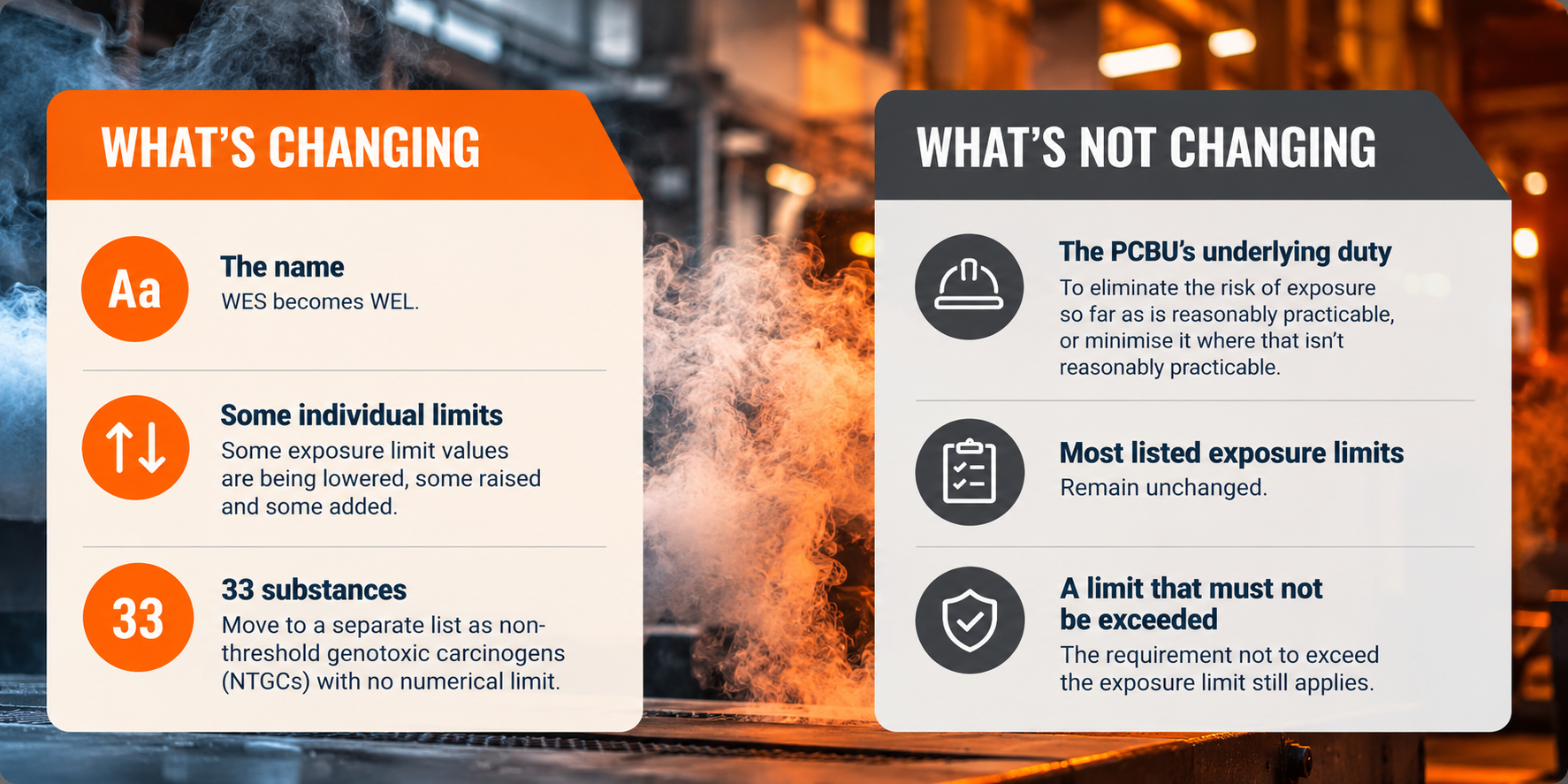
From 1 December 2026, Australia's Workplace Exposure Standards (WES) will become Workplace Exposure Limits (WEL). Alongside the new name, some individual limits decrease, some increase, some are added or restructured, and 33 substances classed as non-threshold genotoxic carcinogens (cancer-causing substances with no known safe exposure level) move off the numerical list altogether. Most listed exposure limits, however, are unchanged.
Until 30 November 2026, the current WES list still applies. The change covers airborne contaminants: dusts, fumes, mists, gases, and vapours that can harm your health when breathed in. They aren't always visible or noticeable by smell, and they can come from the products you use or from the work itself. If your workplace uses or generates any of these, it's worth checking whether any of the contaminants you work with are affected by the WEL changes. Here's what's changing.
Part 1 of our WES to WEL series. Next: preparing your workplace.
What a Workplace Exposure Standard (WES) Is Today
A WES is the maximum airborne concentration of a substance that most people can be exposed to at work, day after day, without harm. "Most" matters, as some people can be affected at levels below it. Breathing in some contaminants can cause health problems ranging from irritation and asthma to lung disease and cancer, which is why exposure is limited. Safe Work Australia's WES list covers more than 600 substances and mixtures. Each is expressed as an eight-hour time-weighted average (TWA), a 15-minute short-term exposure limit (STEL), a peak limitation, or a combination.
Safe Work Australia is a national policy body, not a regulator. It develops the model work health and safety (WHS) laws and the exposure limits list. Each state and territory puts the limits into effect through its own laws, and its own regulator enforces them.
Under the model WHS laws, a person conducting a business or undertaking (PCBU) must ensure no one at the workplace is exposed above the relevant exposure standard. The PCBU is usually the employer. They must also eliminate risks from airborne contaminants so far as is reasonably practicable, or minimise them where elimination isn't possible. Because some people can be affected below the standard, this duty applies even when exposure is under it.
Exposure is measured through air monitoring, which usually means sampling the air a worker breathes during their shift. If you're not sure whether exposure is under the limit, Safe Work Australia says air monitoring must be carried out. Our practical guide to preparing your workplace covers this in more detail.
What Changes on 1 December 2026
Two things happen on 1 December 2026, and it helps to keep them separate.
The name changes. WHS ministers agreed to rename exposure standards as exposure limits. According to Safe Work Australia, the aim is to make clear that the values are limits not to be exceeded, and to align Australia with international terminology. The rename on its own doesn't create a new duty. Safe Work Australia confirms your obligations under the model WHS Regulations don't change because of it.
The list is updated. The WEL list is the outcome of Safe Work Australia's review of the WES, the first since 2003, which assessed values against current health evidence. This is where the real changes sit: for some substances, the number you measure against moves.
Advisory notations are updated, too. Some entries on the list carry short codes, called advisory notations, that flag extra health risks. The WEL changes these in three ways:
- The sensitiser notation (SEN) is split into two. DSEN flags substances that can cause an allergic skin reaction, and RSEN flags substances that can make the airways hypersensitive.
- A new ototoxicity notation (OTO) flags substances that can increase the risk of hearing loss, especially when workers are also exposed to noise.
- The carcinogen notation (CARC) is removed. Whether a substance can cause cancer is still shown on its Safety Data Sheet (SDS) and in Safe Work Australia's Hazardous Chemical Information System (HCIS).
Some individual substances' notations have also changed, so check the notations for anything you work with.

WHS ministers agreed to the WEL list in April 2024, with a transition period to give workplaces time to prepare:
- Until 30 November 2026: comply with the current WES list.
- From 1 December 2026: ensure no one is exposed above the WEL.
These dates apply even where a limit is going up, so you can't switch to a higher WEL early. Each jurisdiction implements the WEL through its own laws, so check with your WHS or mining regulator if you have questions about where you operate.
Are All Exposure Limits Getting Lower? No.
It's easy to assume the WEL tightens everything. It doesn't. Depending on the substance, the review resulted in:
- a lower limit
- a higher limit
- a new limit for a substance that previously had none
- a listing change, such as merging entries, splitting one into separate inhalable and respirable limits, or adding or removing a TWA, STEL, or peak limit
- removal of six substances that are already banned from import, manufacture, and use in Australia: aldrin, chlordane, DDT, dieldrin, endrin, and heptachlor, all older pesticides
Most limits aren't changing at all. Nine substances will also keep their current values from 1 December 2026, because WHS ministers asked for further work on the proposed changes. They include respirable crystalline silica, benzene, and formaldehyde. These limits could be revisited in the future, so it's worth subscribing to Safe Work Australia's updates.
31 New Entries on the List
The WEL adds 31 new entries. Some are substances that had no exposure standard at all, such as diesel particulate matter. Others are new listings for a specific form of a substance that was already covered, such as the respirable fraction of barium sulfate. Many are niche, but several are common on Australian industrial sites:
|
Substance |
New WEL |
Limit type |
Commonly found in |
|
Diesel particulate matter (as respirable elemental carbon) |
0.01 mg/m³ |
8-hour TWA |
Mining, tunnelling, civil construction, and anywhere a diesel plant runs in an enclosed space |
|
Flour (cereal) dust |
0.5 mg/m³ | 8-hour TWA | Food manufacturing and bakeries |
|
Silicon carbide (non-fibrous dust, inhalable) |
10 mg/m³ | 8-hour TWA | Abrasives, grinding and refractory work |
|
Tungsten, metal and compounds (as W) |
3 mg/m³ | 8-hour TWA | Hardfacing, tooling and TIG electrodes |
|
Barium sulfate (respirable) |
1.35 mg/m³ | 8-hour TWA | Drilling fluids and some coatings |
|
Polyvinyl chloride (respirable dust) |
1 mg/m³ | 8-hour TWA | Plastics processing and fabrication |
|
1-Bromopropane |
0.1 ppm | 8-hour TWA | Degreasing and adhesives |
|
Peracetic acid |
0.4 ppm | Peak limitation | Sanitation in food and beverage processing |
A new limit raises a different question from a lower one. If any of these are used or generated on your site, you may not have had a reason to monitor them before. You can see all 31 in Safe Work Australia's comparison of changes.
Why 33 Substances Will Have No Numerical Limit
A non-threshold genotoxic carcinogen (NTGC) is a substance that can damage genetic material and cause cancer, and for which no safe exposure level can be identified. Even short exposures may carry some risk. The review identified 33 airborne contaminants in this group.
Most of the 33 are specialist chemicals, but some turn up regularly on Australian industrial sites:
- Chromium VI compounds (including zinc chromates): welding and cutting stainless steel and high-chrome alloys, chromate primers, and coatings removal.
- Lead chromate: older paints and coatings, particularly during surface preparation and blasting.
- Coal tar pitch volatiles: aluminium smelting, and road works involving older coal-tar-based surfaces.
- Polycyclic aromatic hydrocarbon (PAH) mixtures containing benzo[a]pyrene: some combustion products and fumes, such as from older coal-tar-based materials.
- 1,3-Butadiene: refineries, gas processing and synthetic rubber manufacture.
- Hydrazine: boiler water treatment in power generation and process plants.
- Dinitrotoluene: explosives manufacture and handling.
- Acrylamide: water treatment and chemical grouting.
See the full list of 33 NTGCs on Safe Work Australia's website.
From 1 December 2026, these substances won't have a numerical WEL. That doesn't mean the limit becomes zero, and it doesn't mean they're unregulated.
Instead of measuring against a number, PCBUs must eliminate the risk of exposure so far as is reasonably practicable. Where that isn't reasonably practicable, they must minimise the risk so far as is reasonably practicable. Other requirements, such as those covering certain carcinogens and health monitoring, continue to apply where the regulations specifically list the substance. Until 30 November 2026, the current WES for these substances still apply.
A Few Examples
Five substances show how different the changes can be.
| Substance | Current WES (8-hour TWA) | WEL from 1 December 2026 (8-hour TWA) | Type of change |
|---|---|---|---|
| Manganese | Two entries: dust and compounds (as Mn) 1 mg/m³; fume (as Mn) 1 mg/m³ | One entry, manganese fume, dust and compounds (as Mn): 0.1 mg/m³ inhalable; 0.02 mg/m³ respirable | Merged, split by particle fraction, lower |
| Portland cement | 10 mg/m³ | 1 mg/m³ (respirable dust) | Now measured as respirable dust, lower |
| Diesel particulate matter | No exposure standard | 0.01 mg/m³ (as respirable elemental carbon) | New entry |
| n-Hexane | 20 ppm | 50 ppm | Higher |
| Chromium (VI) compounds (as Cr) | 0.05 mg/m³ | No numerical WEL (listed as an NTGC) | Moved to NTGC treatment |
ppm = parts per million, usually used for gases and vapours. mg/m³ = milligrams per cubic metre of air, usually used for dusts and fumes.
Manganese (common in welding, steelmaking and mining) shows why the detail matters. Two WES entries become one WEL listing with two limits:
- one for the inhalable fraction, meaning particles breathed into the nose and mouth
- one for the respirable fraction, meaning finer particles that reach deep into the lungs
Because the measurement basis has changed, the old and new figures aren't a like-for-like comparison, but both new values are substantially lower.
Portland cement, used across construction, changes in a similar way. The new limit applies only to respirable dust, so it's both lower and measured differently.
Diesel particulate matter previously had no exposure standard. From 1 December 2026, it has a limit, measured using elemental carbon, a marker for the fine soot particles in diesel exhaust.
n-Hexane, a common industrial solvent found in some adhesives and degreasers, is a reminder that some limits rise. Chromium VI (associated with chrome plating and stainless steel welding) shows the NTGC change in action.
These examples are general information only. Check the official WEL list for the exact entry and notations that apply to you, and get workplace-specific advice where needed.
Does This Affect Your Workplace?
You don't need to be an occupational hygienist to get a first read. Questions to ask your team:
- What airborne contaminants do we use or generate? Include chemicals listed in your SDS and those created by the work itself, such as fume, dust or exhaust.
- Are our SDS up to date? Exposure standards appear in Section 8 of an SDS. Older SDS may still quote WES values after 1 December 2026, so check them against the WEL list.
- Are any of them affected? Compare them against Safe Work Australia's summary of changes or the WEL list, or search individual chemicals on the HCIS.
- Has anything become an NTGC, been newly listed or been relisted? New particle fractions or merged entries can change what gets measured.
- Were past monitoring results close to the current WES? Where a limit is falling, those results are worth flagging.
- Where do we currently rely on respirators? Note those tasks, as respirator choices may need reviewing alongside other controls if a limit changes. Our guide to the types of respiratory protection explains the options.
If you answered "yes" or "not sure" to any of these, the next step is working out [what to do about it]([ARTICLE 2 URL]).
What Should You Do Next?
- Check the official sources. Safe Work Australia's WEL list and summary of changes are the authority, not secondary summaries (this one included).
- Look up individual chemicals. Safe Work Australia's updated HCIS shows each chemical's WEL alongside its hazard classifications. Until 30 November 2026, the current WES values still apply.
- Plan your preparation. Our practical guide to preparing your workplace walks through identifying, assessing, controlling and verifying exposures.
- Get specialist help if you need it. An occupational hygienist can assess exposures and carry out air monitoring. The Australian Institute of Occupational Hygienists (AIOH) has a consultant directory.
- Ask your regulator. Your state or territory WHS regulator can explain how the WEL applies where you work. See Safe Work Australia's list of regulators.
Prefer to talk it through? Get in touch with the team at ATOM Safety, or join our WES→WEL webinar for a deeper walkthrough.