
Produced with 3M, with input from Mark Reggers, Certified Occupational Hygienist (COH).
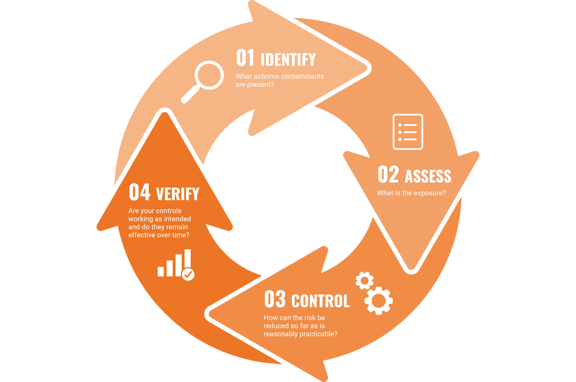
Preparing for Australia's new Workplace Exposure Limits (WEL) comes down to four steps: identify the airborne contaminants your workplace uses or generates, assess your exposure against the new limits, review your controls starting with the hierarchy of controls rather than personal protective equipment (PPE) alone, and verify those controls are effective through monitoring, maintenance, and ongoing assessment.
From 1 December 2026, the WEL list replaces the Workplace Exposure Standards (WES) list, following implementation into the work health and safety (WHS) laws of each jurisdiction. Until 30 November 2026, the current WES values still apply. Most limits aren't changing, but some are being lowered or raised, some substances are being added, and some are being listed differently. This guide focuses on what to do about it.
Part 2 of our WES to WEL series. Start with what's actually changing and why.
New to exposure limits? You'll find definitions in our key terms section at the end of this guide.
A Simple Framework: Identify, Assess, Control, Verify
|
These four steps follow the risk management approach already built into Australia's WHS laws, and line up with Safe Work Australia's advice on preparing for the WEL. Treat them as a cycle, not a one-off checklist. When a material, process, or monitoring result changes, go back to the start. The core duty for a person conducting a business or undertaking (PCBU), usually the employer, hasn't changed. You must eliminate risks from airborne contaminants so far as is reasonably practicable, or otherwise minimise them. "Reasonably practicable" means doing what can reasonably be done, weighing the risk against the controls available. A WEL is a limit that must not be exceeded, not a defined line that marks exposure as "safe" or "unsafe". Your workers are part of this process too. Under WHS laws, PCBUs must consult workers and their health and safety representatives (if they have them), when identifying hazards, assessing risks, and deciding on controls. It's also practical: the people doing the work usually know where the greatest risks and hazards are present. |
 |
Step 1: Identify What's in the Air
Airborne contaminants can be dusts, fumes, mists, gases, and vapours that can harm health when breathed in. To identify them, look at the work and process being done, not just at what you buy.
- Walk through your processes and tasks. Cutting, grinding, sanding, welding, spraying, and running combustion engines can all generate dusts, fumes, mists, vapours or gases, even when no hazardous chemical was purchased.
- Check your Safety Data Sheets (SDSs). They list ingredients, relevant exposure values, and recommended controls.
- Ask your workers. They can point to tasks that feel dusty, smelly, or irritating.
- Record what you find. Note the contaminant, its form, the task, who is exposed, for how long, and how often.
Then compare each contaminant against the current WES and the incoming WEL using Safe Work Australia's summary of changes. Safe Work Australia's free Hazardous Chemical Information System (HCIS) can also help you look up hazard classifications and exposure limits. Some changes are significant. Diesel particulate matter, for example, gets a new limit of 0.01 mg/m³ measured as respirable elemental carbon, and Portland cement drops from 10 mg/m³ to 1 mg/m³ as respirable dust. Look beyond the number. Has the exposure type changed, for example, from inhalable (larger particles) to respirable (the finer particles that reach deep into the lungs)? Has the listing been merged or split? Have the notations, the advisory flags for extra risks, changed?
Three situations are worth flagging:
- Nine substances stay at their current values for now. WHS ministers didn't agree to proposed changes for nine chemicals, including respirable crystalline silica, benzene, and formaldehyde, so their limits remain at current WES values from 1 December 2026. Further work is ongoing.
- Non-threshold genotoxic carcinogens (NTGCs) won't have a numerical WEL. These substances can damage genetic material, and no exposure level can be identified as protective. That doesn't mean the limit is zero. You must eliminate the risk so far as is reasonably practicable, or minimise it using the hierarchy of controls.
- Some substances carry a skin notation. For these, absorption through the skin may be a significant exposure pathway. Exposure limits and respirators only deal with what's breathed in, so you'll also need controls that prevent skin contact, such as suitable gloves and protective clothing.
Step 2: Assess Your Exposure Information
Next, check whether your existing risk assessments and air monitoring data still hold up under the new limits. Ask your team:
- Is it current? Data from several years ago may no longer reflect how you work.
- Is it representative? It should match today's processes, equipment, production levels, and controls.
- Is it relevant? It needs to cover the right contaminant, exposure fraction, and exposure period.
- Can it be compared with the WEL? A result that sat comfortably under an old WES may be close to, or over, a lower WEL.
Do Your Shift Lengths Change the Picture?
Most limits are an 8-hour time-weighted average (TWA): the average concentration over an 8-hour day, based on a 40-hour work week. Longer shifts, such as the 10- and 12-hour rosters common in mining and construction, mean more exposure and less recovery time. The TWA may need to be adjusted downwards for these rosters. The WEL list says a TWA can't be adjusted upwards for shorter shifts; short-term exposure limits (STELs, a 15-minute average) and peak limitations (a maximum at any moment) can't be adjusted at all, and PCBUs should get a qualified professional such as an Occupational Hygienist to calculate shift adjustments.
When Is Air Monitoring Legally Required?Air monitoring means measuring the concentration of a contaminant in the air a worker breathes, usually with a sampling device worn in their breathing zone during a representative shift or task. The WEL change doesn't automatically require every workplace to carry out new air monitoring. Under the model WHS Regulations (the national template each state and territory adopts in its own version), a PCBU must ensure air monitoring is carried out if they are not certain, on reasonable grounds, whether the airborne concentration of a substance exceeds the relevant exposure limit, or if monitoring is necessary to determine whether there is a health risk. |
|
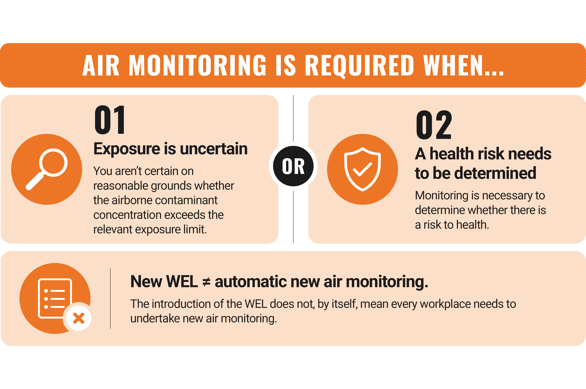
In practice, a lower limit may create uncertainty that didn't exist before. For NTGCs, Safe Work Australia advises there's no requirement to conduct air monitoring, although you may choose to monitor to check your controls are working.
Where monitoring is needed, it should be carried out by a competent person: someone with the training, qualifications, and experience to plan the sampling, carry it out, and interpret the results. That's often an occupational hygienist, a specialist in measuring and controlling workplace health hazards. A Certified Occupational Hygienist (COH) holds the highest professional certification awarded by the Australian Institute of Occupational Hygienists (AIOH). Mark Reggers, who contributed to this guide, is one of them. Safe Work Australia's Guide for PCBUs: Air monitoring and the workplace exposure limits explains how to engage one and what to do with the results. Monitoring records must be kept for at least 30 years (40 years for asbestos) and be accessible to workers.
What If Results Are Above the Limit?
If monitoring shows exposure above the WEL, you need to act. That means reviewing and improving your controls, working through the hierarchy of controls from top (elimination being most effective) to bottom (PPE being least effective), and protecting workers in the meantime. Then check again to confirm the changes are effective. Some jurisdictions also have notification requirements. For example, SafeWork NSW requires notification when the exposure standard for respirable crystalline silica is exceeded. Check with your regulator.
Air Monitoring vs Health Monitoring
The two are easy to confuse. Air monitoring measures what's in the air during work activities. Health monitoring checks the worker after exposure has occurred, using medical tests carried out or supervised by a doctor to detect changes in health from exposure.
Under the model WHS Regulations, a PCBU must provide health monitoring where there is a significant risk to a worker's health from exposure to a hazardous chemical listed in Schedule 14 of the Regulations, or from another hazardous chemical where suitable testing methods are available. Lead and asbestos have their own requirements. Health monitoring isn't a substitute for effective controls, but it can reveal when controls aren't working.
When to Get Specialist Advice
Specialist occupational hygiene advice is worth seeking when exposures are complex, several contaminants are present at once, results are borderline or uncertain, a hazard is unfamiliar, workers are on extended shifts, or you need a monitoring program designed or interpreted. The AIOH has a directory to find an occupational hygiene consultant. If you're a smaller business unsure where to start, some regulators offer free support; SafeWork NSW, for example, provides free advisory visits.
This article is general information only and isn't a substitute for a workplace-specific exposure assessment. It refers to the model WHS laws. Requirements vary between jurisdictions (Victoria, for example, operates under separate OHS laws), so check with your WHS or mining regulator.
Step 3: Control the Risk
Start With the Hierarchy of Controls
|
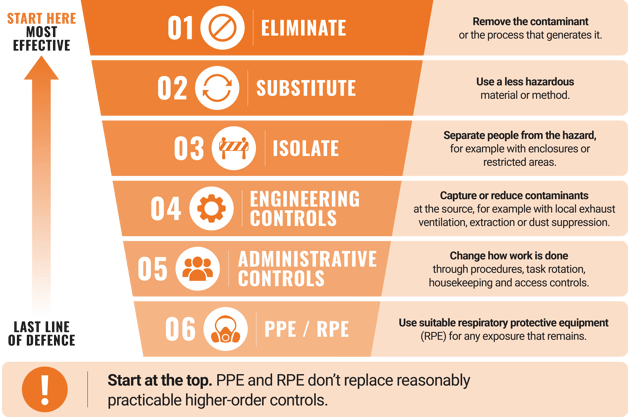
A changed limit may mean your control strategy needs another look, but it doesn't mean every workplace needs new equipment. Where controls do need to change, work through the hierarchy, starting with the most effective controls:
Under the model WHS Regulations, substitution, isolation, and engineering controls sit at the same level and can be used alone or in combination. What matters is that you've used them, so far as is reasonably practicable, before relying on administrative controls and PPE. |
|
A Closer Look at Engineering and Administrative Controls
Local exhaust ventilation captures contaminants at or near the point where they're generated, before they reach a worker's breathing zone. A typical system has a hood or capture point close to the source, ducting, a filter or collector, and a fan. It's different from general ventilation, which dilutes contaminants across a whole space. General ventilation has its place, but on its own, it's rarely enough for significant sources and exposures. A pedestal fan can even blow contaminants towards workers or spread them around the workplace.
LEV only works effectively and reliably if it's designed for the task, used correctly, and kept in good condition. Under the model WHS Regulations, control measures must be maintained so they remain effective, so build regular inspection and performance testing into your maintenance schedule. Other engineering options include water sprays and on-tool extraction, which captures dust directly at the tool.
Administrative controls support, rather than replace, higher-order controls. Housekeeping is a good example. Wet wiping or an H-class vacuum removes settled dust, while dry sweeping or compressed air puts it back into the air.
Safe Work Australia is specific about RPE: the protection it provides can only be taken into account when determining compliance with the WEL once all reasonably practicable higher-order controls are in place or been evaluated, and the RPE is selected, worn, and maintained correctly. For a refresher on the options, see our guide to different types of respiratory protection.
Reassessing Your Respiratory Protection
If RPE is part of your control strategy, the WEL change is a good prompt to check if it still will provide the required exposure reduction.
Respirators don't eliminate exposure; they reduce it. Under AS/NZS 1715, each type of respirator has an assigned a protection level that reflects how much it's expected to reduce exposure when it's correctly selected, fitted, worn, and maintained. The question is whether the gap between the concentration in the air and the limit is within what your respirator can reliably reduce. If the limit drops or exposure is higher than expected, that gap widens, and you may need a higher protection level or better upstream controls. A higher limit doesn't automatically mean you should upgrade to a respirator with a higher protection factor, because current respiratory may still be adequate, but this is not known without assessing the situation.
Respiratory protection standards are changing, too. Australia and New Zealand are transitioning from AS/NZS 1715:2009 and AS/NZS 1716:2012 to a broader suite of ISO-based standards, including the AS/NZS ISO 16975 series. Standards Australia says both frameworks will operate in parallel until 2030. The new suite classifies products using protection classes rather than respirator type alone, so you may see products rated under either framework during this time and beyond. Where it matters, confirm a product's classification and protection factor with the manufacturer.
From the expert: Mark Reggers, Certified Occupational Hygienist, 3M
"The new standards don't change what a respirator is there to do, but they do change how its classification is. During the transition and beyond, you'll see products rated under both systems, so you can't compare a number from one directly with a number from the other. Check the classification with the manufacturer, and make sure it is suitable for the application. RESP-FIT have a free online respirator selector tool to help workplaces with this transition and holistic respirator selection"
Selecting a respirator is only one part of a respiratory protection program. A good program also covers:
- Suitability. Whether workers are medically suited to wearing RPE.
- Fit and compatibility. Including fit testing where required, and how the respirator works with eyewear, hard hats, and hearing protection.
- Training. Correct use, fit checking, storage, and maintenance.
- Maintenance. Inspection, cleaning, and filter and cartridge replacement.
- Records. Selection decisions, fit tests, and training.
Under the model WHS Regulations, PPE must be a suitable size, conform and fit for the worker and be maintained so it keeps protecting them, and workers must receive information, training, and instruction on its use.
What About Fit Testing?
A fit test checks whether a particular respirator model and size can seal properly on a particular worker's face. It should be done by a competent fit tester (e.g RESP-FIT Accredited fit tester) using specific methodologies. A fit check is different: it's the quick seal check a worker does every time they put a respirator on. Both matter, but a fit check doesn't replace a fit test.
Fit testing applies to tight-fitting respirators, including disposable half masks, reusable half-face and full-face respirators, and tight-fitting powered air-purifying respirators (PAPRs). AS/NZS 1715 and SA/SNZ TS ISO 16975.1 requires fit testing for tight-fitting RPE. More detailed fit-testing procedures are also set out in AS/NZS ISO 16975.3:2023. Loose-fitting positive-pressure hoods and helmets, where a fan pushes filtered air into the headtop, don't rely on a tight face seal. AS/NZS 1715 and SA/SNZ TS ISO 16975 advises they don't require fit testing, although they still need to be correctly fitted and supplied with adequate airflow.
Guidance from WorkSafe WA and SafeWork NSW says fit testing should happen before a tight-fitting respirator is first worn, whenever a new make or model is issued, and when facial changes, such as significant weight change, may affect the seal. Guidance on ongoing frequency differs: SafeWork NSW says at least annually, while WorkSafe WA says regularly, based on risk assessment. Keep a written record of each test and use a competent tester. RESP-FIT is the industry accreditation program. Our article on why fit testing matters explains more.
Ready to review your RPE?
Once you know the level of protection you need, ATOM's respiratory protection range covers disposable, reusable and powered options from multiple brands. For workers who can't get a reliable face seal, for example because of facial hair, a loose-fitting PAPR such as the 3M™ Versaflo™ TR-300 may be an option, provided it offers the protection level your assessment requires.
Browse respiratory protection at ATOM View 3M™ Versaflo™ TR-300+
Step 4: Verify Your Controls Are Working
Verification is where you check that your controls are doing what they should. Depending on your risks, that may include:
- Monitoring. Air monitoring where it's required or useful, and health monitoring where it applies.
- Engineering checks. Inspecting and testing the extraction and ventilation performance.
- RPE program checks. Confirming fit tests and training are current.
- Records. Checking maintenance logs and documentation.
- Investigations. Following up on incidents, complaints, or unexpected results.
Verification isn't the end of the process. Under the model WHS Regulations, you must review control measures when they aren't effectively controlling the risk, before a workplace change likely to create a new or different risk, when a new hazard is identified, when consultation indicates a review is needed, or when a health and safety representative (a worker elected to represent their work group on health and safety) requests one. Scheduling regular reviews on top of these triggers is good practice.
Changes to processes, substances, equipment, production levels, shift patterns, work practices, exposure information, or the applicable limits should send you back to Step 1.
Putting It Together: An Example
This is an illustrative scenario only. Imagine a small maintenance workshop with a solvent parts washer and a bench grinder.
-
Identify: the supervisor walks the floor with the team, checks the solvent's SDS, and learns its WEL is lower than the current WES. Grinding dust is also noted.
-
Assess: the workshop's only air monitoring is five years old and was done before the washer was moved into a smaller room, so the owner can no longer be certain on reasonable grounds that exposure is under the new limit. An occupational hygienist is engaged.
-
Control: the team first asks whether a less hazardous cleaning product would do the job, then looks at a lid and local extraction for the washer and on-tool extraction for the grinder, with respirators kept for the remaining exposure.
-
Verify: the hygienist re-samples after the changes, extraction checks are added to the maintenance schedule, and a note goes in the risk register to repeat the review if the workshop changes products or layout.
A Simple WEL Readiness Checklist
Use these questions as a high-level self-check with your team. They're a starting point for review, not a declaration of compliance.
| Step | Questions to ask your team |
|---|---|
| Identify | Have we listed every airborne contaminant our processes use or generate, with input from workers? Have we checked each one against the current WES and incoming WEL, including exposure type, notations, and NTGC status? |
| Assess | Is our exposure or air monitoring data still current and representative, and does it account for our shift lengths? Do we know when air monitoring and health monitoring are legally required for us, and who is competent to do them? |
| Control | Have we considered elimination, substitution, isolation, and engineering controls before relying on PPE? If we use RPE, does it still provide enough protection under the new limit? |
| Verify | Are our control checks, fit tests, and training records current and documented? Do we have a trigger to restart this review when a process, material, roster or piece of equipment changes? |
What Should You Do Next?
- Start with Step 1. A current list of your contaminants makes every other step easier, and may show that many of your limits aren't changing at all.
- Talk to your team. Consultation is a legal duty and the quickest way to find out where exposure actually happens.
- Get support on site. ATOM Safety can visit your site, review your current safety equipment, and trial suitable products with your team.
Want a deeper walkthrough of what this means for your workplace?
Where to Learn More
If you want to go deeper, these are the most useful places to start.
Official WEL Resources
- Workplace exposure limits for airborne contaminants (the WEL list), Safe Work Australia
- Removal of exposure limits for NTGCs, Safe Work Australia
- Your state or territory WHS regulator, or mining regulator, for how the WEL applies where you operate
Monitoring and Health
- Technical guide: Air monitoring and the workplace exposure limits, written for occupational hygienists and technical specialists
- Health monitoring, Safe Work Australia
- Model Codes of Practice: Managing risks of hazardous chemicals in the workplace and How to manage work health and safety risks
Prefer to talk it through? Get in touch with the team at ATOM Safety, or join our WES→WEL webinar for a deeper walkthrough.